
AI coding tools are generating code faster than teams can safely review, test and deploy it.
If you multiply code generation by 10x but leave operations and QA manual, you get a massive backlog, fragile infrastructure and mountains of sloppy code.
The bottleneck has moved from writing code to everything that happens after: pull request reviews, infrastructure orchestration, release management and continuous feedback loops.
Historically, building deep automation across these workflows was a luxury only massive organizations with dedicated platform teams could afford. Today, it is a survival requirement.
To truly leverage AI, engineering teams need unprecedented levels of automation. Every organizational behavior, approval check and operational skill must be codified into executable, transparent workflows.
Introducing the Cloud Beta
Today, we are opening the SuperPlane Cloud beta. SuperPlane is an open source automation engine built to help companies transform into AI-native organizations.
It unifies software creation with the operations of production systems. It does not replace your existing tools; it orchestrates them. By treating both AI agents and human engineers as first-class citizens, SuperPlane lets you incrementally build workflows that span across your stack: from Git repositories to CI/CD systems, observability platforms and communication channels.
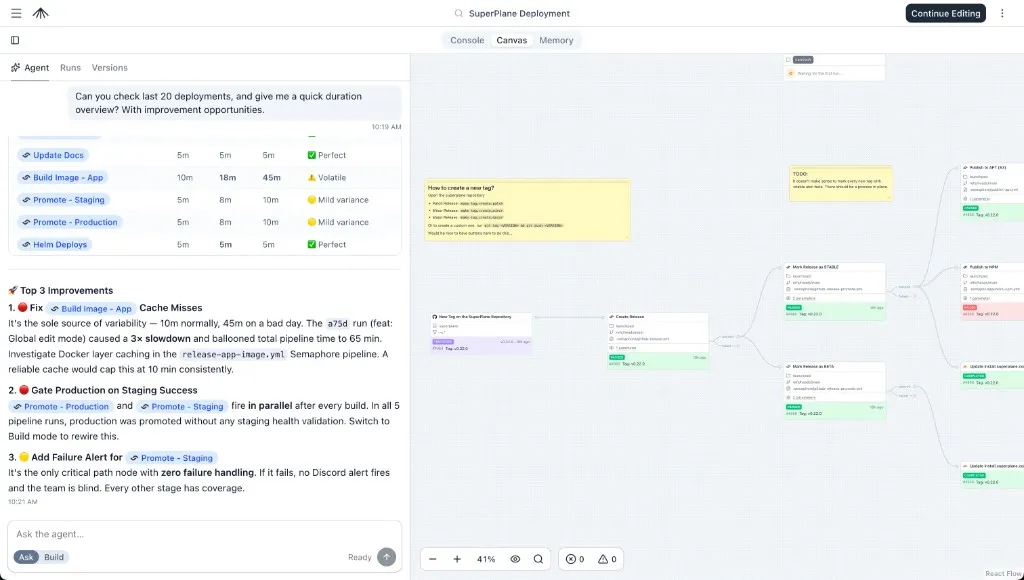
It lets you model high-velocity workflows as fully operational Apps. Each SuperPlane App is a single deployable unit that brings together your workflow graphs, custom UI and execution logic.
For example, a single App can catch a GitHub pull request, spin up an ephemeral preview environment on AWS, run automated tests and post the live URL back as a comment.
SuperPlane Apps are backed by Git and execute deterministically using graphs, providing the exact guardrails AI needs to safely interact with your tools.
What you can build
SuperPlane handles workflows that are too complex for a single script or CI job.
- AI-driven code review: Automatically review pull requests, enforce style guides, perform QA and calculate change risk scores using LLMs.
- Release management: Coordinate deployments that span hours or days, incorporating automatic health checks, manual approvals and instant rollback paths.
- Operational dashboards: Unify data from any engineering event into a custom live UI. Track DORA metrics, active incidents, or deployment health across your stack.
- Continuous feedback loops: Pull context from observability tools, build custom data pipelines for production metrics and feed real-time usage data directly back to the engineering team and their coding agents.
The Architecture of an Automation Engine
To understand how SuperPlane bridges the gap between AI coding tools and your runtime infrastructure, it helps to look at the architecture.
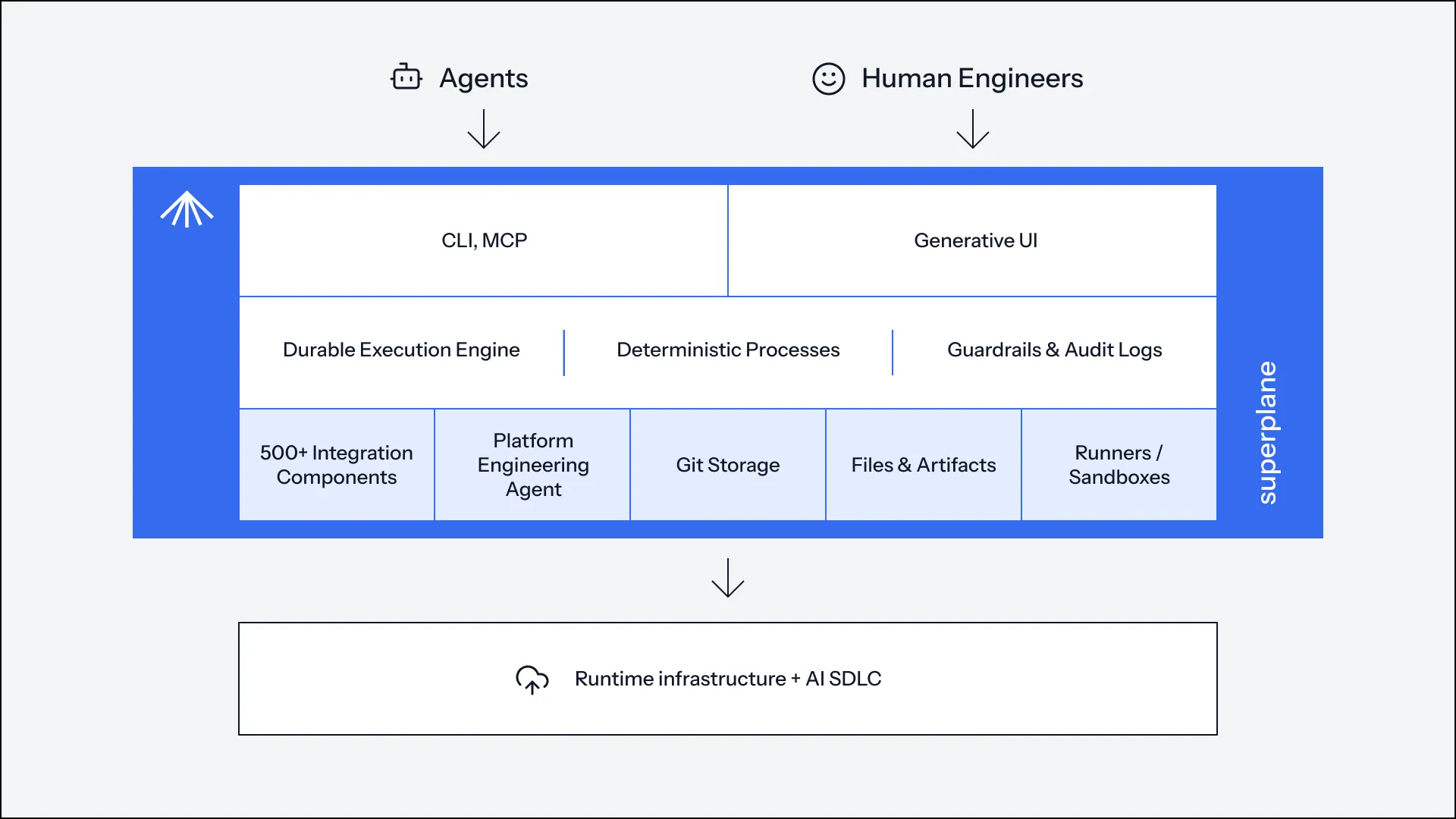
SuperPlane is designed to treat AI agents and human engineers as equal participants in the SDLC:
- Dual Interfaces: Human engineers interact with workflows via the Generative UI and console, while external coding agents (like Codex or Claude Code) interact via the CLI and Model Context Protocol (MCP).
- The Execution Engine: At its core is a durable execution engine that runs deterministic processes. If a multi-step deployment fails halfway, SuperPlane knows exactly where it stopped and how to recover, while maintaining strict guardrails and audit logs.
- Building Blocks: The engine orchestrates over 500 integration components, managed runners and Git-backed storage to interact safely with your runtime infrastructure and external APIs.
Why we built a managed service
SuperPlane is open source and you can self-host the core execution engine. But orchestrating event-driven workflows at scale requires significant infrastructure.
The Cloud beta provides the easiest path to running SuperPlane in production. It also introduces capabilities that are difficult to manage locally:
- Managed runners: Execute arbitrary Python or TypeScript code as part of your workflows without provisioning or maintaining infrastructure.
- Built-in Platform Engineering Agent: Unlike external coding agents that write product code, this built-in agent operates directly on your canvas. It acts as your platform engineering assistant by building workflow graphs, debugging execution failures and managing app repository files, all while respecting your RBAC permission boundaries.
- Shareable Apps: Because Apps are backed by Git, the Cloud service lets you install shareable workflows into your organization with a single click, using parameter forms instead of manually editing YAML.
Try the Cloud beta
You can sign up for the managed service today at app.superplane.com.
To see the platform in action, join our YouTube Live stream tomorrow. We will walk through the architecture, demo the built-in agent and answer questions.
If you prefer to run things locally, the demo container is the fastest way to start.
Join the SuperPlane community: